Written by
John
Published on
September 6, 2026

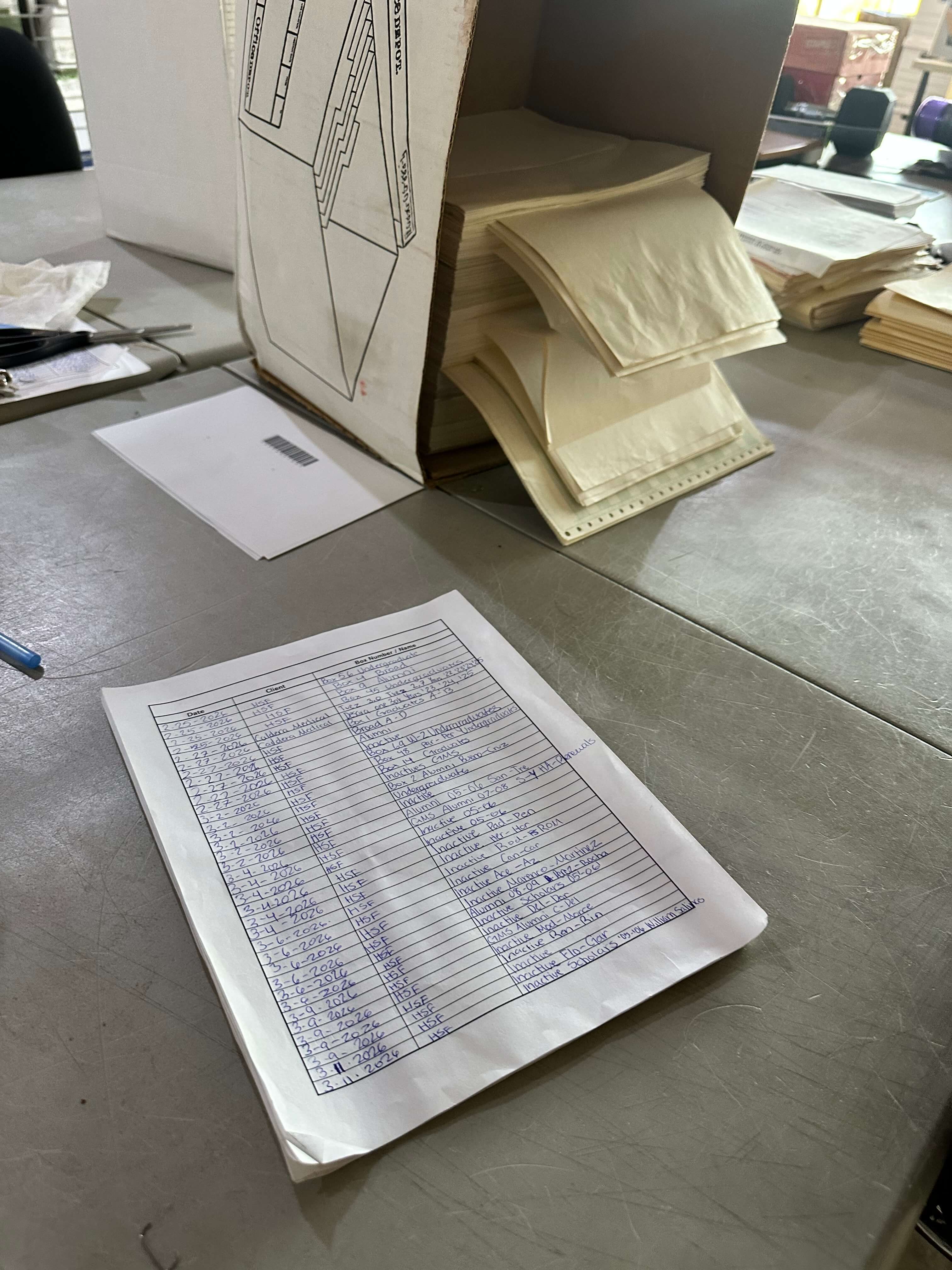
We're a document scanning company. Our entire reason for existing is to take paper out of your office and turn it into clean, searchable, digital files. On a normal day, our production floor moves tens of thousands of pages from paper into pixels.
So here's something that surprises people who tour our operation: one of the only documents we create on purpose — in ink, on actual paper — is our production log.
Every person who works in production keeps one. By hand. All day.
It's a small thing. It's also one of the most important quality and accountability tools we have. This post explains what a production log is, why a company built to eliminate paper deliberately runs on it, and what that single sheet says about the difference between a professional scanning operation and someone who simply owns a scanner.
A production log is a simple, handwritten running record that every member of our production team keeps at their station. For each box of documents they handle, they write down four things:
That's it. No software, no login, no dashboard. A pen and a spreadsheet printout. And yet that sheet quietly does four jobs that most people never stop to think about — and every one of them protects the client.
Scanning is detail work at volume. Across a large project, a single box passes through preparation, scanning, quality control, and indexing. The overwhelming majority of the time, everything goes perfectly. But "most of the time" isn't a standard we're willing to stand on.
If a question ever comes up about a specific file — a page that looks off, a document a client can't locate, a box that needs to be revisited — the production log lets us go back in time. We pull the log, find the box number, and see exactly who worked it and when. Even if that was months ago.
That turns a vague problem ("something seems wrong with a file from that project") into a precise one ("box 47 was prepped on March 4th — let's talk to the person who handled it and find the root cause"). Problems get solved at the source instead of guessed at. That's the difference between an operation that can answer for its work and one that just hopes the question never comes.
For a lot of the records we handle, knowing who touched what — and when — isn't just convenient, it's part of the job. Law firms, medical practices, and other regulated businesses operate under genuine accountability requirements, and we treat their documents accordingly.
The production log acts as an internal, chain-of-custody-style record that runs alongside any formal chain of custody a project calls for. When a box of legal files or protected medical records moves across our floor, the log is one more layer documenting that the right person had the right box on the right day. It complements — and reinforces — the controls that are already in place from the moment we pick your boxes up.
Production work is repetitive by nature, and we're not going to pretend otherwise — we also don't run a sweatshop. Our team is welcome to put in headphones and listen to podcasts or music while they work. People do focused, repetitive work better when they're comfortable, and a good operation respects that.
But comfort isn't the same thing as drift. The production log sits out in the open, at every station, where the whole team can see it. It's a running, visible record of what's actually getting done. That visibility creates a natural, shared sense of cadence — everyone can see the work moving, and that keeps a steady, healthy pace without a manager standing over anyone's shoulder. It's accountability built into the workflow instead of bolted on top of it.
Because the log records who worked which box on which day, it also gives us a clear, after-the-fact view of how much labor a given box — or a given project — actually took. That matters for two reasons.
First, it keeps our pricing honest. When we tell you what a project costs, that number is grounded in real production data, not a number pulled out of the air. Second, it helps us see which boxes and document types eat the most time, so we can plan future projects more accurately and tell you up front what's likely to be straightforward and what's likely to be complicated.
There's something genuinely funny about a company whose entire mission is getting rid of paper, deliberately creating paper every single day. We've made our peace with it. The production log isn't a contradiction — it's the thing that keeps the rest of the operation honest.
And that's really the larger point. The difference between a professional document scanning company and "a person with a scanner" was never the scanner. Anyone can buy a scanner. The difference is process — the boring, disciplined habits that make quality repeatable and mistakes traceable. The handwritten log is one of dozens of those habits, and it's exactly the kind of thing that gets skipped when scanning is treated as an afterthought, or when a business tries to handle it in-house with staff who already have ten other jobs.
Professional operations build accountability into the floor. Amateur ones hope for the best. If you've got a project where the details matter — and with your records, they always do — that discipline is what you're actually hiring.
Have a scanning project coming up? Get a quote from Turn Source Imaging and we'll walk you through exactly how your documents will be tracked, handled, and returned.