Written by
John
Published on
September 6, 2026

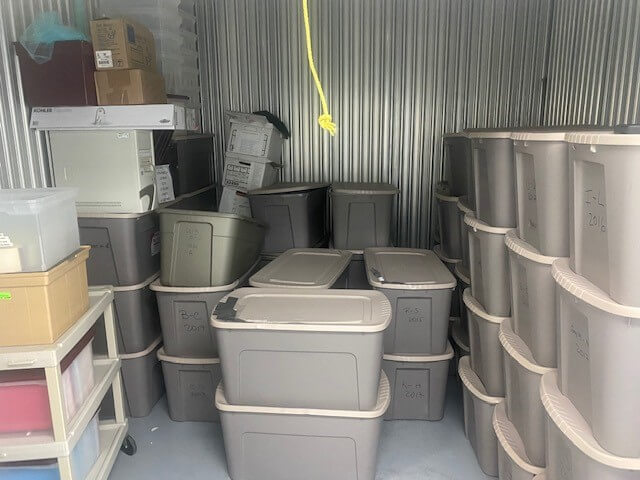
Every business that has been operating for more than five years has a backfile problem. Storage units full of banker's boxes. Basement rooms stacked with filing cabinets. Off-site warehouses charging monthly fees for records nobody has touched in years. Back offices where the supply closet became a document graveyard.
Backfile scanning is about the past — what to do with the historical paper archive that has been accumulating for years or decades. Faded pages, fragile binders, retention-period reviews, the institutional memory locked inside file cabinets nobody has opened. While bulk document scanning focuses on the production logistics of moving high volumes through scanning at scale, backfile scanning focuses on the archive itself: what’s in it, what to keep, what to retire, and how to make decades of business history searchable again. Done right, it eliminates storage costs permanently, makes years of historical records actually accessible, and removes the compliance risk of paper archives that could be lost, damaged, or destroyed. This guide covers everything Southern California businesses need to know before launching a backfile scanning project — from when it makes sense, to what it costs, to how to evaluate vendors. For broader context, also read our complete document digitization guide.
Backfile scanning — sometimes called backfile conversion or backfile digitization — is the process of digitizing historical paper records that have already accumulated. It's the opposite of day-forward scanning, which digitizes new documents as they arrive.
The distinction matters because backfile projects have specific characteristics:
Backfile scanning often gets postponed indefinitely because it's a project, not a crisis. But specific situations make it urgent:
Storage units in Southern California run $200-$400/month in LA and OC, $150-$300/month in the Inland Empire. After 5-10 years of paying for storage, businesses have often spent more on storage fees than they would have spent on a one-time backfile scanning project. The math is decisive once you run the numbers. Read our complete analysis of the real cost of paper for Southern California businesses.
Moving a Southern California office is expensive. Carrying decades of paper archives to the new location is paying for square footage you don't need. Most backfile projects we work on are triggered by an upcoming move. Read our guide on scanning documents before an office move.
A compliance audit, a discovery request in litigation, or a regulatory review can suddenly make a backfile scanning project urgent. Being able to produce specific records from a digital archive is dramatically faster and more reliable than searching through boxes of paper. Read our complete guide to California business record retention requirements.
Due diligence for any significant business transaction includes a review of historical records. Buyers want digital access, not boxes of paper. Selling a business with a digitized archive is meaningfully easier than selling one with a paper archive that the buyer will inherit responsibility for.
When founders or long-tenured leaders transition out, the historical knowledge embedded in their paper archives is at risk. Backfile scanning preserves that institutional memory in a format the next generation of leadership can actually access.
Southern California businesses that have experienced earthquakes, wildfires, or floods know that paper records cannot be recreated once destroyed. A backfile scanning project is fundamentally an insurance policy against catastrophic loss of historical records.
Every backfile project starts with an inventory of what you actually have. For large projects, this typically includes an on-site walk-through of your storage location to count boxes, evaluate document condition, identify special handling requirements, and confirm volume estimates.
Not every document in your backfile needs to be digitized. Some records have hit the end of their retention period and can be securely destroyed without scanning. A pre-scanning retention review can significantly reduce project cost. Read our complete California record retention guide by industry.
For large backfile projects, a pilot batch — typically 1,000-5,000 pages of representative documents — confirms quality, naming convention, and indexing approach before the full project begins. Pilot batches catch problems early when they're easy to fix.
Backfile pickups are typically scheduled in tranches rather than all at once. This keeps the project moving steadily, maintains chain of custody throughout, and gives us continuous QC opportunities. We pick up directly from your storage unit, office, warehouse, or wherever your archive is currently stored. Read more about how our pickup and delivery process works.
Every document is prepared, scanned, OCR-processed, and indexed according to your specifications. Learn more about our OCR and data capture process.
For long backfile projects, we deliver digitized files in batches throughout the project so you can start using portions of the archive immediately rather than waiting for the entire project to complete.
After your final approval, original documents are either returned to you or securely destroyed with a certificate of destruction. For records past retention, secure destruction is typically the right call.
Backfile patient chart conversion is one of the most common projects we handle. California's CMIA requires 10-year retention for adult patient records — meaning healthcare backfiles can run into hundreds of thousands of pages. HIPAA-compliant handling is required throughout. Read our complete guide to HIPAA-compliant medical records scanning.
Historical case files, closed matter archives, and trust account records. Read our guide for Southern California law firms.
Historical transaction files spanning multiple years of closed escrows. Read our guide for escrow companies going paperless.
Particularly common across the Inland Empire's logistics corridor — historical vendor contracts, compliance records, HR files for large workforces, and operational documentation.
FAR-compliant retention requirements mean defense contractors often have decades of contract documentation. San Diego County alone has 15,000+ businesses holding DOD contracts — many with significant backfile needs. Read our San Diego County document scanning guide.
Backfile scanning is typically priced per page, with rates that decrease at higher volumes. Document condition, indexing complexity, and turnaround requirements all affect pricing. Read our complete guide to document scanning costs in Southern California and what affects scanning pricing.
Realistic backfile project timelines:
Backfile scanning is one of the most clear-cut business cases in document management. Every month you delay is another month of storage fees, another month of inaccessible records, and another month of risk exposure. The math is decisive — businesses that do this once never regret it.
Once your backfile is digitized, the natural next step is preventing new paper from accumulating. Day-forward scanning programs continue capturing new documents as they arrive, so you never end up back where you started. Read more about our day-forward and ongoing scanning programs.
Ready to Tackle Your Backfile?
Turn Source Imaging provides backfile scanning with pickup and delivery throughout Southern California. Free consultation, on-site assessment, and pilot batch scan available. Contact us at (714)-276-1111 Option 1 or Online