Law Firm Document Management Statistics 2026: 35 verified numbers on how law firms store, secure, and work with documents, from cloud and AI adoption to breach rates, billable utilization, and California's client file retention rules. Every figure is traced to the ABA, Clio, the State Bar of California, or the study that published it, dated, and linked. Last updated September 2026.
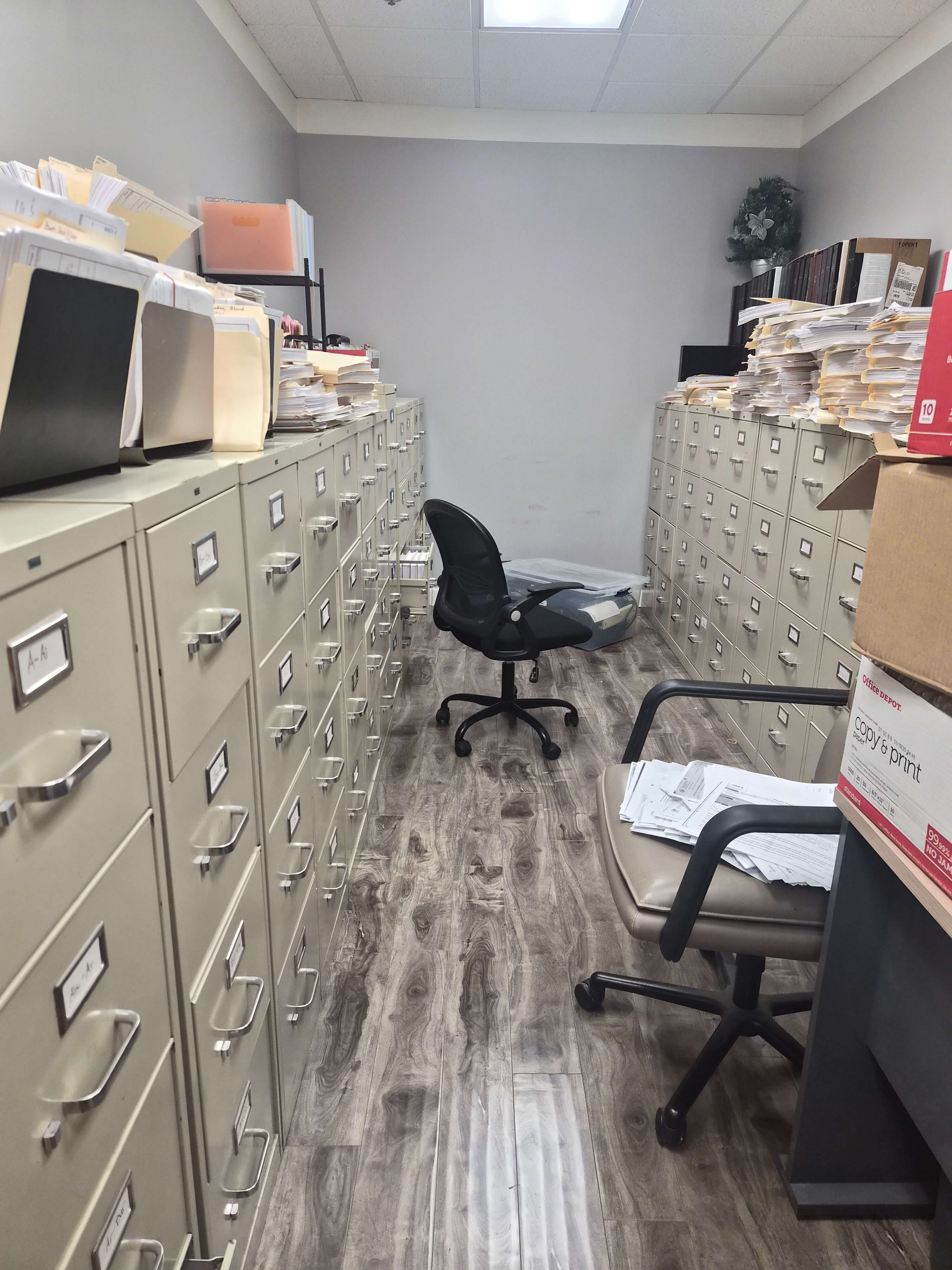
Law firms are the most paper-intensive clients we scan. Closed matters sit in banker's boxes for years because nobody is sure what the retention rule is, and the retention rule in California is, in fact, unclear. This page collects the numbers that matter for a managing partner or office administrator deciding what to do with the file room: how fast the profession is moving to cloud and AI, how often firms get breached, how much of a lawyer's day is actually billable, and what the State Bar says about keeping and destroying client files.
Primary sources only. Each number is attributed and dated. We refresh this page when the ABA and Clio publish new surveys.
Key Takeaways
- About 75% of attorneys use cloud computing for work, up from 60% in 2021; solos are lowest at about 65%, firms of 50 to 99 lawyers are above 94% (ABA 2024 Legal Technology Survey).
- 73% of firms use cloud-based legal tools, led by document management and practice management software (ABA, 2024).
- 85% of litigators file electronically (ABA, 2024).
- AI adoption nearly tripled in one year, from 11% of firms in 2023 to 30% in 2024 (ABA, 2024).
- 79% of legal professionals now use AI in their daily work, up from 19% in 2023 (Clio Legal Trends Report, 2024).
- The average lawyer records only 2.9 billable hours in an 8-hour day, a 33% utilization rate (Clio).
- Up to 74% of hourly billable tasks could be automated, including 81% of legal secretary and administrative tasks (Clio, 2024).
- 29% of law firms have experienced a security breach, and another 19% do not know whether they have (ABA Cybersecurity TechReport).
- Only 60% of firms have a formal cybersecurity policy (ABA, 2024).
- California attorneys must keep client trust account records for five years after final distribution (California Rule of Professional Conduct 1.15).
- Criminal defense files in serious felony cases must be kept for the client's entire term of imprisonment, and may be kept digitally only if every item is copied (California Penal Code 1054.9).
How much of a lawyer's time goes to documents instead of billable work?
- The average lawyer records just 2.9 hours of an 8-hour day as billable work, a utilization rate of about 33%. The rest goes to administrative work, document management, and routine communication. Source: Clio Legal Trends Report, as summarized by Clio, 2026.
- Up to 74% of hourly billable tasks, such as information gathering and data analysis, could be automated with AI. 81% of legal secretary and administrative assistant tasks are automatable, versus 57% of lawyer tasks. Source: Clio Legal Trends Report 2024, October 2024.
- Firms with above-average productivity bill more than the industry average of 33% of their workday. Source: Clio Legal Trends Report 2024.
- Firms with wide AI adoption are nearly 3x more likely to report revenue growth, and 77% of firms that grew revenue with AI attribute it to improved operations such as document generation, workflow automation, and client communication. Source: Clio Legal Trends Report 2025, October 2025.
- Growing firms are 2x more likely to use automation than stable firms and nearly 3x more likely than shrinking firms. Firms with flat utilization rates see declining revenue per lawyer over five years. Source: Clio Legal Trends Report 2025.
- 36% of legal professionals report AI has had a positive effect on revenue; among wide adopters, 69%. Source: Clio Legal Trends Report 2025 (full report).
- 59% of firms used flat fees exclusively or alongside hourly rates in 2024, and firms charge 34% more of their cases on a flat-fee basis than in 2016. Source: Clio 2025 report via the Illinois Supreme Court Commission on Professionalism, and Clio 2024.
How far have law firms moved to cloud and digital documents?
- Approximately 75% of attorneys use cloud computing for work-related tasks, up from 69% in 2023, 70% in 2022, and 60% in 2021. Solo practitioners are the slowest adopters at about 65%; more than 94% of attorneys at firms of 50 to 99 lawyers use cloud. Source: ABA 2024 Cloud Computing TechReport, April 2025.
- Among the roughly 25% who have not adopted cloud, 53% cite confidentiality and security concerns, 41% cite lack of control over data, and 31% cite unfamiliarity. Source: ABA 2024 Cloud Computing TechReport.
- 93% of attorneys rate cloud vendor reputation as important, but fewer than a quarter actually evaluate vendor history or seek peer recommendations. Source: ABA 2024 Cloud Computing TechReport.
- 73% of firms use cloud-based legal tools, with document management and practice management software showing the highest adoption. Source: ABA 2024 Legal Technology Survey Report press release, March 3, 2025.
- 85% of litigators use electronic court filings. Source: ABA 2024 Legal Technology Survey Report.
- 67% of attorneys use fee-based online legal research services and 55% rely on free platforms. Source: ABA 2024 Legal Technology Survey Report, via ICLR.
- 76% of legal organizations have adopted cloud technologies, and 87% of attorneys prefer working at firms that invest in modern tools. Source: industry survey data compiled by Software Finder, May 2026 (secondary source; included for the 87% preference figure).
How fast are law firms adopting AI for document work?
- 30% of firms used AI-based tools in 2024, up from 11% in 2023. Among firms with 100+ attorneys, 46% (up from 16%); firms of 10 to 49, 30% (up from 11%); solos, 18% (up from 10% and none in 2022). Another 15% were seriously considering purchase. Source: ABA 2024 Legal Technology Survey Report (512 attorneys), as reported by LawSites, March 2025.
- Accuracy is the top AI concern for 75% of attorneys, up from 58% in 2023, followed by reliability (56%) and data privacy and security (47%). Source: ABA 2024 survey via LawSites.
- 79% of legal professionals now incorporate AI into their daily work, up from 19% in 2023. 70% of clients either prefer or are neutral toward firms that use AI. Source: Clio Legal Trends Report 2024.
- 82% of legal professionals expect to use more AI in the next 12 months, yet more than half of firms have no AI policy or staff are unaware of one. Source: Clio Legal Trends Report 2025, via Forward Push, October 2025.
- Among wide AI adopters, 20% report challenges meeting billable targets and 45% have adjusted pricing: a quarter raised prices, 11% reduced them, and 8% added AI-specific fees. Only 36% of clients say they would be less likely to trust a lawyer who uses AI. Source: Clio 2025 via 2Civility, April 2026.
- In a separate survey of 2,800 legal professionals, personal AI use rose from 27% (2023) to 31% (2024), while firm-wide adoption fell from 24% to 21%. Firms with 51+ lawyers reported 39% generative AI adoption; firms with 50 or fewer, about 20%. Source: Federal Bar Association, Legal Industry Report 2025, April 2025. Note the gap between this survey and Clio's 79%: definitions of "use" differ widely, and we show both rather than pick the flattering one.
- Every AI tool in these surveys operates on digital documents. A closed file in a banker's box is invisible to all of them.
How often do law firms get breached?
- 29% of law firms report having experienced a security breach (lost or stolen device, hacker, break-in, or website exploit), 52% report none, and 19% do not know. The "don't know" share rises with firm size: 29% for firms of 10 to 49 attorneys, 41% for 100 to 499, and 60% for 500+. Source: ABA 2023 Cybersecurity TechReport.
- 60% of firms have implemented formal cybersecurity policies; phishing and ransomware remain the leading threats. Source: ABA 2024 Legal Technology Survey Report.
- 80% of firms had at least one technology insurance policy in 2023, but only 34% had an incident response plan. Source: ABA data as compiled by BD Emerson.
- 20.92% of law firms experienced a cyberattack in the prior year, and 70.86% say they choose vendors based on data privacy policy. Source: U.S. Legal Support 2024 Data Privacy Trends Survey, via Software Finder.
- Ransomware attacks on law firms fell from 45 incidents compromising 1.5 million records in 2023 to 11 incidents compromising 7,016 records in 2024. Source: Programs.com, Law Firm Cyberattack Statistics, June 2026.
- Only 42% of law firms maintain a written incident response plan, and just 9% of solo practitioners do. Source: Caislean Consulting, compiling ABA and industry data, December 2025.
How long must California law firms keep client files?
There is no single statute. The rules come from the Rules of Professional Conduct, State Bar ethics opinions, and one section of the Penal Code. Here is what each actually says.
- Attorneys must preserve records of client funds and property for five years after final distribution. Source: California Rule of Professional Conduct 1.15(d)(5) (formerly Rule 4-100(B)(3)), as explained in Ethics in Brief: The File Retention Puzzle, May 2025.
- The State Bar's formal opinion sets no specific retention period for client files in civil matters. The attorney must retain items that could reasonably prejudice the client if destroyed, and must use a destruction method that ensures no breach of confidentiality. Source: State Bar of California Formal Opinion 2001-157.
- The Los Angeles County Bar Association recommends a minimum of five years past the date a civil matter closed, by analogy to the trust account rule. Source: LACBA Formal Opinion 475 (1994), cited in State Bar Opinion 2001-157.
- Files in criminal matters should not be destroyed without the former client's consent while the client is alive. Source: State Bar Formal Opinion 2001-157.
- Where a client was convicted of a serious or violent felony with a sentence of 15 years or more, trial counsel must retain the file for the term of the client's imprisonment, and may keep it in electronic form only if every item in the file is digitally copied and preserved. Source: California Penal Code section 1054.9(g), as discussed in State Bar proposed Formal Opinion 19-0004.
- Absent an agreement, in civil matters a lawyer may destroy client materials only after using reasonable means to notify the client and giving a reasonable time to respond. The proposed opinion expressly permits electronic preservation. Source: State Bar proposed Formal Opinion 19-0004, via Ethics in Brief.
- The ABA Model Rule 1.15 floor is also five years, and several states set six or seven (New York six, Illinois seven). Source: Attorney Protective, December 2025.
What this means for a Southern California firm with a file room
The retention rules push in one direction: keep it, and keep it in a form you can produce. Five years is the floor for civil files, criminal files can be the client's lifetime, and Penal Code 1054.9 makes digitization explicitly acceptable as long as it is complete. That is an argument for scanning closed files rather than storing them, because a partial scan of a criminal file does not satisfy the statute and a box in offsite storage does not satisfy a malpractice discovery request on a deadline.
The productivity data points the same way. At 2.9 billable hours a day, the non-billable five are where document handling lives. Every AI and automation tool in the surveys above needs the file to be digital first.
We wrote a practice-specific guide to document scanning for law firms in Southern California, and our backfile scanning guide covers how a closed-file conversion is priced and sequenced. For the broader picture, see our document scanning and digitization statistics page.
How to cite this page
Turn Source Imaging, "Law Firm Document Management Statistics 2026," turnsourceimaging.com, updated September 2026. Please cite the original publisher alongside this page. If a figure has been revised at its source, email us and we will update it.
Sources
Have a file room full of closed matters in Los Angeles, Orange County, or San Diego? Get a quote from Turn Source Imaging. We scan a free sample batch first, and we document chain of custody on every box.